Close
Close


Your shopping basket is empty
We offer so much stuff that you can't choose? :-)
Contact us, We will be happy to advise you
Get to know opalite up close in our encyclopedia, which you can view below by clicking Show more. ↓
Interested in something specific? Skip the text and go straight to the topic Symbolism and healing properties, Suitable zodiac signs, Localities and history, What is the mineral used for and what can you make from it? or Connection with chakras.
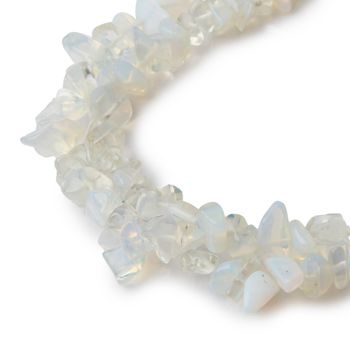
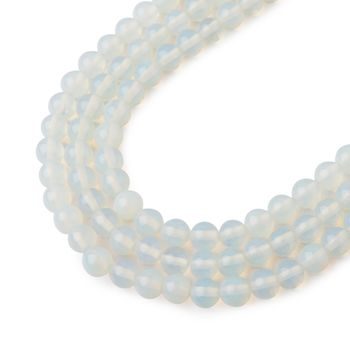
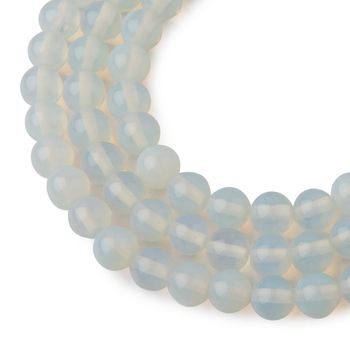
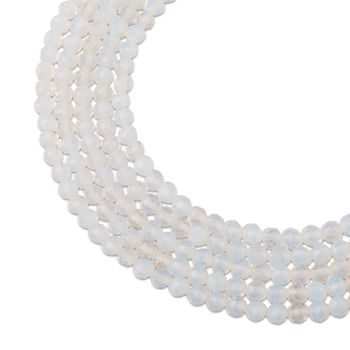
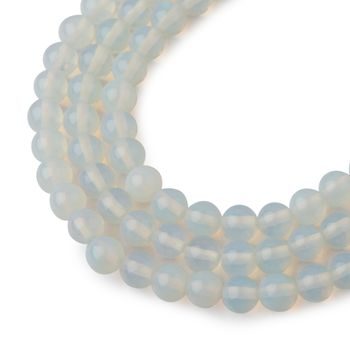
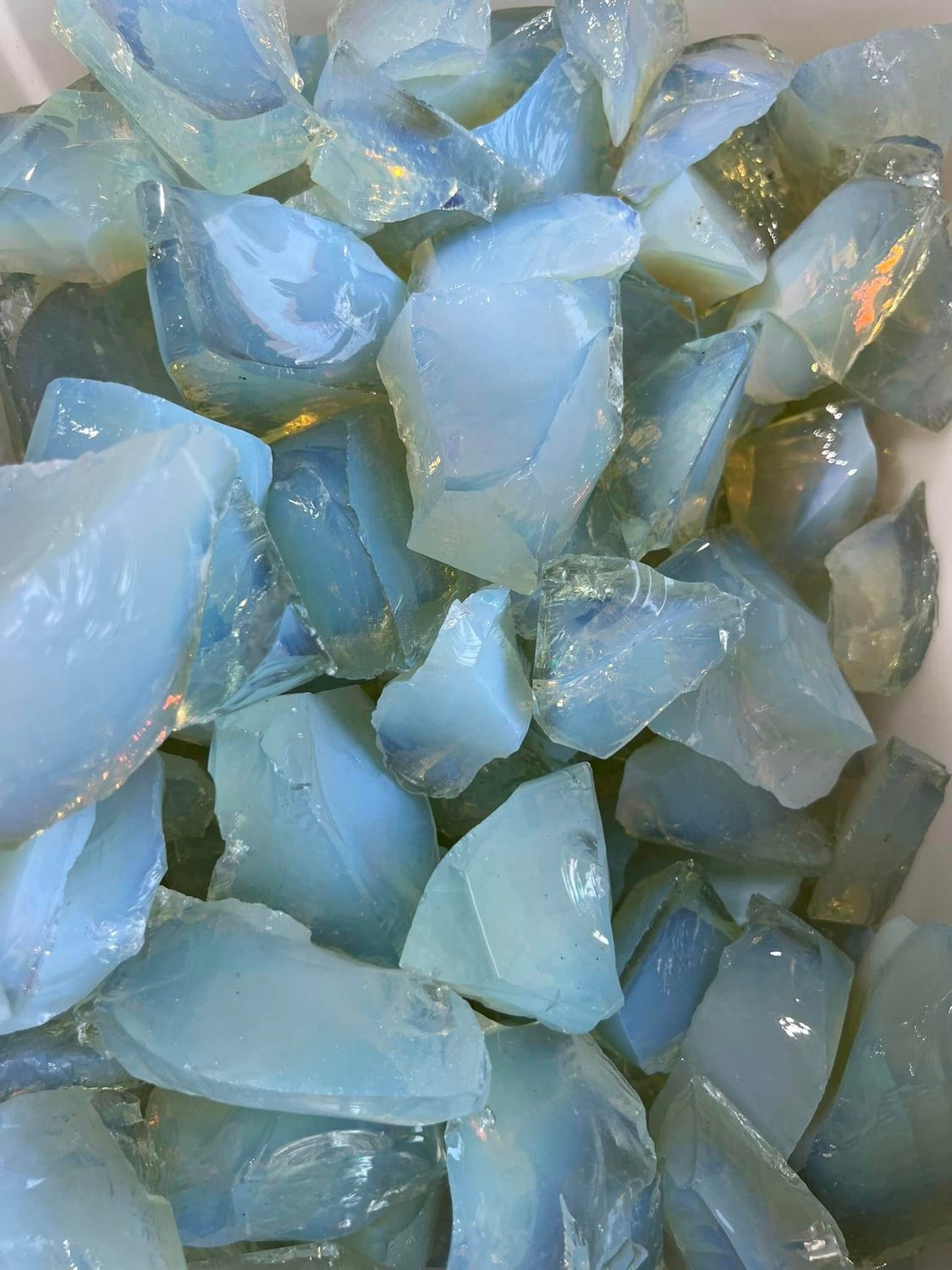
Opalite is associated with emotional balance. It reportedly supports the expression of emotions and helps with communication. It occurs in milky white, grey or yellowish colour. Sometimes it can also have a pinkish or bluish tinge. It is traditionally linked with the Greek goddess of love, beauty, passion and harmony, Aphrodite. It is said to have a calming effect on the mind and to reduce anxiety and stress. According to astrology, it helps develop intuition and spiritual abilities.
People also seek it out for its supportive effects when it comes to love and passion. Some people believe that wearing opalite can support loving relationships and attract love into life. In alternative medicine it is used mainly in crystal therapy, during meditation and in energy balancing. It is said to have protective effects, shielding its wearer from negativity and providing protection against harmful influences. It is also often associated with developing creativity and inspiration.
Gemini (22 May – 21 June), Cancer (22 June – 22 July), Libra (23 September – 23 October) and Scorpio (24 October – 22 November)
Also take a look at our encyclopedia of minerals by zodiac sign and find out more here >>>
Opalite is a man-made stone that was created in a laboratory by processing natural opal. It is therefore not a naturally occurring mineral, and so it does not have a natural locality like other, natural stones.
Synthetic opalite is created using special laboratory techniques. The base material for producing this stone is glass or polymer. This base substance is prepared and shaped into the required form, for example the shape of a stone, beads or plates. A small amount of silicon dioxide is then added, and sometimes also pigments and other additives to achieve the desired colour and effects. The mixture is then heated in special furnaces, during which the material transforms and crystallises. Once the desired properties are achieved, the material is gradually cooled to stabilise the structure and effects created. The result is synthetic opalite. On the Mohs scale, its hardness corresponds to 5.5 to 6.
Opalite was created relatively recently, and therefore does not have a particularly long history unlike other stones. Thanks to its properties, it has become very popular in jewellery making.
Did you know that people also seek out opalite because it reportedly supports personal transformation? It is highly sought after among people for this property.
In jewellery making, opalite is widely used to make necklaces, bracelets and earrings of various lengths and shapes. In rings it is used as the main stone, but is also often used in combination with other gemstones. Opalite is also often used to make original clasps and brooches. It is also very well suited for decorating vases, statues and glass balls.
5th chakra – throat chakra Vishuddha: reportedly affects communication and self-expression
6th chakra – third eye chakra Ajna: reportedly affects spiritual growth and awareness
7th chakra – crown chakra Sahasrara: reportedly affects the ability to calm the mind
Also take a look at our encyclopedia of minerals by chakra and find out more here >>>
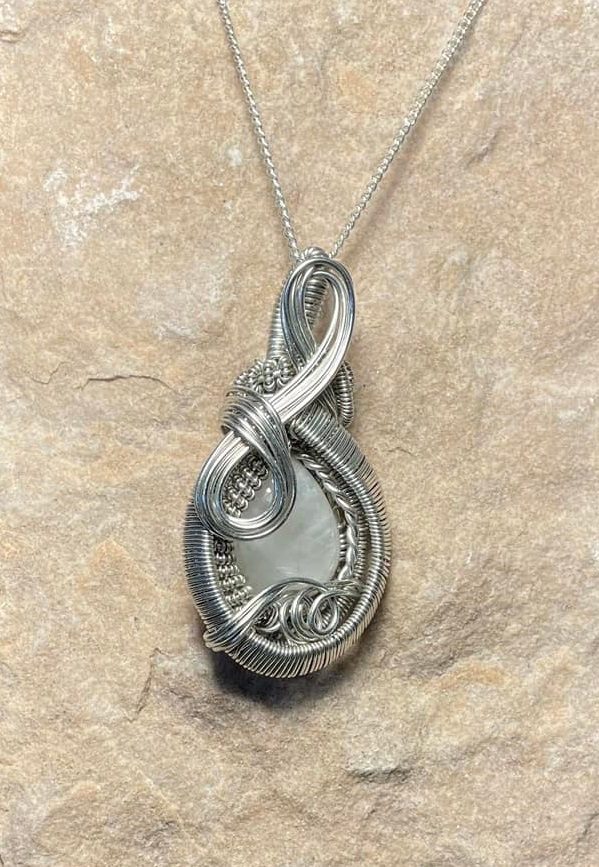
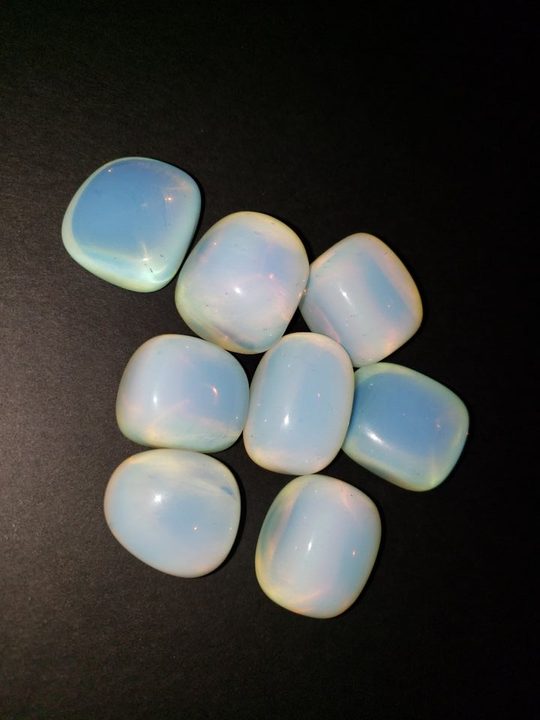
NOTICE: Information about the properties of precious stones and minerals found on all e-shops operated by Manumi Crafts s.r.o. is not intended for the diagnosis or treatment of any illness, and does not replace or serve as an alternative to conventional medical care. All information about the potential effects of minerals is based solely on publicly available sources, which cannot be factually verified. All precious stones and minerals in our range are intended solely for aesthetic and decorative purposes.



| In design | synthetic mineral |
| Size | 5 - 8 mm |
| Hole width | 1 mm |
| Product code | 48464 |
| In design | synthetic mineral |
| Size | 4 mm |
| Hole width | 0,7 mm |
| Product code | 48902 |
| In design | synthetic mineral |
| Size | 8 mm |
| Hole width | 1,2 mm |
| Product code | 48904 |
| In design | synthetic mineral |
| Size | 4 mm |
| Hole width | cca 0,8 - 1 mm |
| Product code | 49453 |
| In design | synthetic mineral |
| Size | 6 mm |
| Hole width | 1 mm |
| Product code | 48903 |
| In design | synthetic mineral |
| Size | 2 mm |
| Hole width | cca 0,4 - 0,6 mm |
| Product code | 49451 |
| In design | synthetic mineral |
| Size | 3 mm |
| Hole width | cca 0,5 - 0,7 mm |
| Product code | 49452 |
 Everything is in stock for immediate dispatch
 Affordable delivery to EU
 Traditional Czech glass quality
 Discounted price for larger packages