Close
Close


Your shopping basket is empty
We offer so much stuff that you can't choose? :-)
Contact us, We will be happy to advise you
Get to know kyanite up close in our encyclopedia, which you can view below by clicking Show more. ↓
Looking for something specific? Skip the text and jump straight to Symbolism and healing properties, Suitable zodiac signs, Localities and history, What is the mineral used for and what can you make from it? or Connection with chakras.
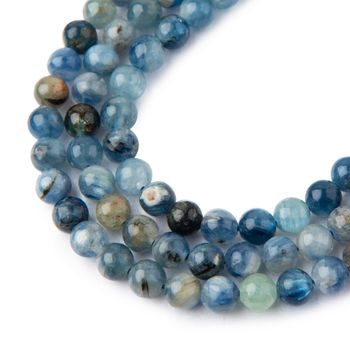
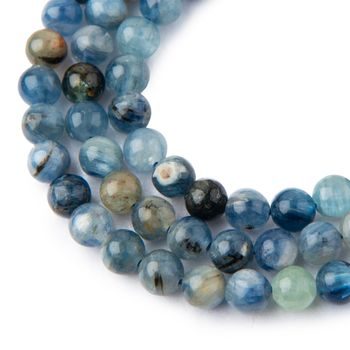
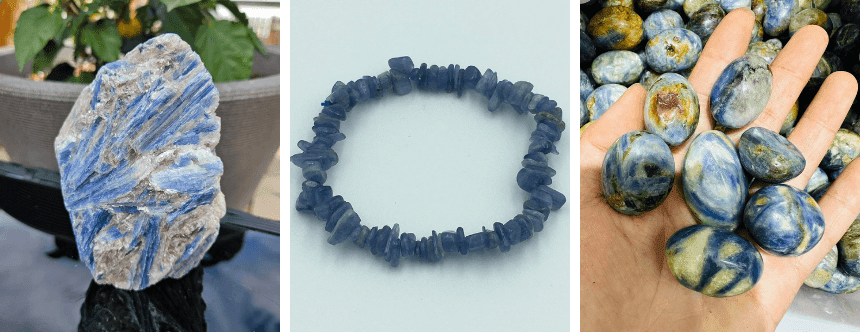
Kyanite is associated with balance and calm. It is believed to help harmonise and calm emotional imbalance and stress. It is usually blue in colour, from light blue to intense dark blue. However, it can also occur in white, grey, green, or even be colourless. It is traditionally linked to Athena, the Greek goddess of wisdom, strategy and war. According to astrology it is said to have strong protective properties and to cleanse energy.
People also seek it out for its reported harmonising effect. This mineral is also very often associated with strengthening intuition and receptiveness. It is believed to help develop and strengthen the ability to perceive subtle energetic vibrations and to attune to inner wisdom. In alternative medicine it is also often used for meditation. It is frequently associated with supporting spiritual growth and consciousness. It reportedly also helps open inner knowledge and develop spiritual skills. It is also often associated with communication and self-expression.
Taurus (21 Apr – 21 May), Gemini (22 May – 21 Jun) and Sagittarius (23 Nov – 21 Dec)
Also take a look at our encyclopedia of minerals by zodiac sign and find out more here >>>
Significant localities include Brazil, India, Nepal, the USA, Myanmar, Russia and Australia.
In nature, kyanite is found in the form of columnar crystals with a regular hexagonal cross-section of various sizes. It is also found in the form of grains. In any case, natural kyanite has very strong properties, and is therefore widely used across many fields all around the world. On the Mohs hardness scale it corresponds to 5.5 to 7.
The history of kyanite goes back to ancient times. The Egyptians, Greeks and Romans were very fond of it for its beautiful colour. Kyanite was officially named in 1789 by the German mineralogist Abraham Gottlob Werner. Today it is very popular for making jewellery.
Kyanite is also known as the blue steel stone because of its hardness and beautiful blue colour. This name refers to its resemblance to steel and its industrial use as an abrasive material.
Kyanite is highly valued, particularly in jewellery making, for its beautiful blue-white colour. Rings, necklaces, earrings and bracelets are made from it. It looks very attractive combined with other minerals, such as diamond, sapphire or topaz.
You can also make pendants, amulets, talismans and figurines or statuettes from it. Mineral pictures or kyanite hair jewellery also look very good. It is also often used to decorate keyrings and fashion accessories. There really are no limits to your imagination.
5th chakra – throat chakra Vishuddha: affects communication and self-expression
6th chakra – third eye Ajna: affects intuition, spiritual vision and clairvoyance
7th chakra – crown chakra Sahasrara: affects spiritual growth and consciousness
Also take a look at our encyclopedia of minerals by chakra and find out more here >>>
NOTICE: Information about the properties of precious stones and minerals found on all e-shops of Manumi Crafts s.r.o. is not intended for the diagnosis or treatment of any illness, and does not replace conventional medical care nor serve as an alternative to it. All information provided about the potential properties of minerals is based solely on publicly available sources that cannot be factually verified. All precious stones and minerals in our range are intended exclusively for aesthetic and decorative purposes.



| In design | natural mineral |
| Size | 6 mm |
| Hole width | 0,8 mm |
| Product code | 48828 |
| In design | natural mineral |
| Size | 8 mm |
| Hole width | 1 mm |
| Product code | 48829 |
 Everything is in stock for immediate dispatch
 Affordable delivery to EU
 Traditional Czech glass quality
 Discounted price for larger packages