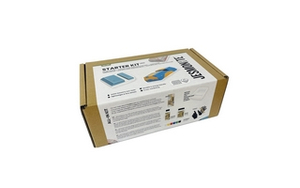
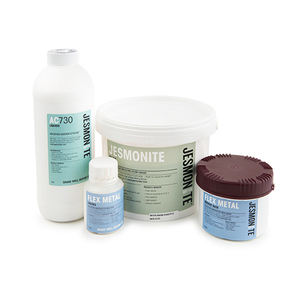
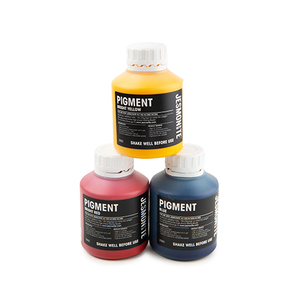
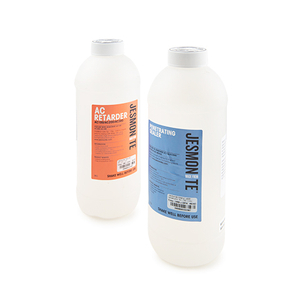
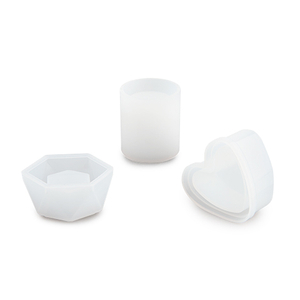
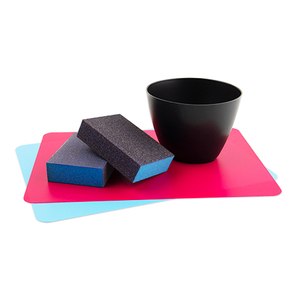
As the first ones in the Czech Republic, as an official distributor we’d like to present Jesmonite material. Pouring ecological resin with which you can easily make interesting decorations in modern minimalist or scandi style. Its advantage, as opposed to the crystal resin, is that you can take a finished smaller product out of a mould after only a couple dozen minutes! With Jesmonite, you’ll achieve a super trendy terrazzo effect, marbling or color blocking. Make small decorations that will make you happy every day.
I saw Jesmonite material for the first time at the beginning of 2021 thanks to foreign Youtubers. I was immediately impressed not only by the appearance of finished products, but mainly by how quickly it cures. It wasn’t available here at that time so we started to strive for its distributorship. I really enjoy exploring the possibilities of combining Jesmonite with other materials - resin, acrylic markers or candle wax.
Video: How to craft from Jesmonite
Basic information and frequently asked questions
What’s the difference between crystal resin and Jesmonite?
From the visual point of view, the difference
is definitely the transparency. You can dye resin using powders to make it
opaque. You can dye Jesmonite but it will always remain opaque, its look
resembling a gypsum casting.
From the production point of view, Jesmonite
differs in the fact that it consists of liquid and powder parts that harden
after mixing in a couple dozen minutes. Therefore you have much less time for
working with the material but the finished product can be taken out of the
mould after as soon as 30 minutes (for example, a coaster).
How do I make what I want from Jesmonite?
Jesmonite is a pouring material that, after
mixing both components together, has a consistency similar to pancake batter.
So you always have to have a silicone mould into which you’ll pour it and the
shape of which it then acquires. You can use the same moulds for Jesmonite as
you use for crystal resin. They just need to be thoroughly cleaned up every
time.
How do I find out how much material I need for a given mould?
If you don't have a good estimate in your eye
yet, you can pour water into the mould and then pour that into a measuring cup.
This way, you’ll find out what volume the given mould has. Jesmonite AC100 has
a mixing ratio of 2.5 : 1 and you need 175 g of the mixture for a 100 ml big
mould. AC730’s ratio is 5 : 1 and for a 100 ml mould, you need 185 g of the
mixture.
In case you prepare more material than you
need for a mould, spread the rest of it onto baking paper to make chips for a
terrazzo effect for another product.
How can I dye Jesmonite?
Although it might seem that inks used for
crystal resin will dye Jesmonite, this is not the case. Due to its chemical
composition, Jesmonite needs its own pigments that will ensure good richness
and permanency of colour. You’ll definitely choose from our range. Remember
that combinations of various pigments will achieve completely different shades
and colours than those originally in the bottles. It’s enough to use just a
really small amount of pigments. As little as 2 drops is sufficient to dye
enough material to make one coaster. The total amount of pigments in the mixture
should not exceed 2 %.
Is Jesmonite waterproof?
Jesmonite itself is definitely better off
than, let’s say, self-hardening clay. But if you want to use it, for example,
for making a flower pot or an outdoor decoration, we recommend always using a
sealer. It will close the material off nicely and protect it from the influence
of both moisture and weather.
It’s still us, we just changed from Korálky.cz to Manumi. Ale nemusíte se bát, pořád u nás najdete všechny vaše oblíbené produkty, inspiraci a servis v kvalitě, na kterou jste zvyklí ;)
We want to bring you relevant information, creative inspiration and convenient shopping on our e-shop. To do this, we need to store your cookies. What information and how we store it read here.Reject cookiesAllow cookies
 Close
Close



 Zuzana Dobšíčková
 Everything is in stock for immediate dispatch
 Affordable delivery to EU
 Traditional Czech glass quality
 Discounted price for larger packages