Close
Close


Your shopping basket is empty
We offer so much stuff that you can't choose? :-)
Contact us, We will be happy to advise you
Get to know the giant clam shell up close in our encyclopedia, which you can view below by clicking Show more. ↓
Interested in something specific? Skip the text and jump straight to Symbolism and healing properties, Suitable zodiac signs, Localities and history, What is the mineral used for and what can you make from it? or Connection with chakras.
The giant clam shell (tridacna) is associated above all with the cleansing of body and mind. It is believed that the sound it is able to produce has a cleansing effect. It is therefore used in meditations and rituals to achieve calm and harmony. The most common colour of the giant clam shell is white or cream, although shades of yellow, orange and even pink also exist. These are rarer. It is traditionally linked to Lakshmi, the Hindu goddess of wealth, prosperity and abundance, who is often depicted holding a giant clam shell in one hand. The giant clam shell is also associated with the most important god in Hinduism, Vishnu. According to astrology, it is regarded as a symbol of luck and abundance.
People also seek it out for its protective properties. It is believed that its presence and sound vibrations remove negative energy, ward off evil forces and protect against danger. In alternative medicine, it is used in meditation, where it is said to facilitate connection with the divine and the sacred. That is why it is used in religious ceremonies. It is a symbol of transcendence and connection with higher consciousness. It is also often associated with harmonising effects, renewal and the flow of energy.
Also take a look at our encyclopedia of minerals by zodiac sign and find out more here >>>
The giant clam shell naturally occurs in seas and oceans. It is therefore found all over the world, especially in tropical and subtropical regions. The main localities are the Indian Ocean, the Bay of Bengal, the Gulf of Thailand and the Pacific Ocean.
In nature, the giant clam shell occurs in several shapes and forms, which also vary in size. They are most commonly found as specimens measuring 10 to 15 cm, but larger shells can exist, reaching lengths of over 20 cm. In any case, the natural giant clam shell reportedly has strong properties and is used around the world. On the Mohs hardness scale, it corresponds to a value of 2.5.
The history of the giant clam shell goes back thousands of years. It is associated above all with Hindu, Buddhist and spiritual traditions in South Asia. In Hinduism, it is regarded as a sacred symbol used in religious ceremonies, such as Puja (ritual worship), and for sounding signals to announce religious activities. The giant clam shell also often appears in Indian epic texts such as the Mahabharata and the Ramayana, where it is frequently mentioned in connection with heroes and battles. Historically, it was also recognised at various festivities, ceremonies and social events.
That the giant clam shell, also nicknamed the Shankha, is unusual in that its spiral whorls run in the opposite direction to the whorls of all other shells? This phenomenon is called sinistral (left-handed) coiling. In nature, all other shells have dextral (right-handed) whorls, meaning their spirals turn clockwise. With the giant clam shell, it is the opposite. It is therefore considered rare.
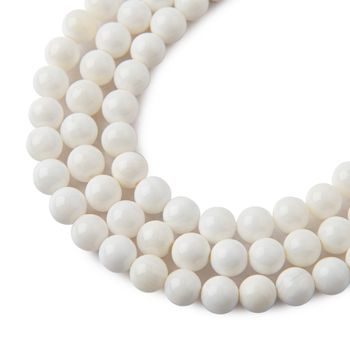
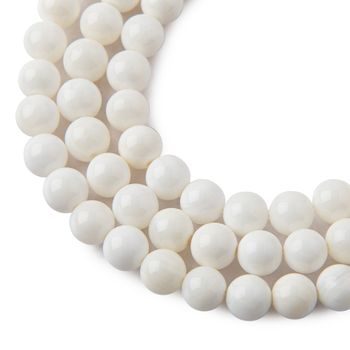
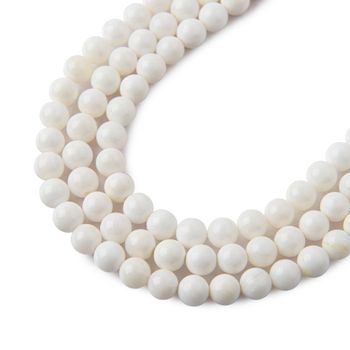
With its unique texture and shape, the giant clam shell has become a highly valued element, especially in the jewellery industry. It gives jewellery a very natural and exotic look. It is used above all to make bracelets and necklaces, which are further combined with other materials, such as wood or metal. The giant clam shell is also processed into various shapes and then used to make earrings. Some rings may even contain elements of giant clam shell.
You can also make a musical instrument from the giant clam shell. The giant clam shell is, after all, very characteristic for its sound. It is popular to use this mineral for decorative purposes, for example by placing it in a vase with sand and other ornaments, such as crystals or sand. It is also often used as a ritual vessel in various ceremonies, or processed into figurines, statues and sculptures.
6th chakra – third eye Ajna: affects intuition, spiritual vision and clairvoyance
Also take a look at our encyclopedia of minerals by chakra and find out more here >>>

NOTICE: The information on the properties of gemstones and minerals found on all e-shops operated by Manumi Crafts s.r.o. is not intended for the diagnosis or treatment of any illness, and does not replace or serve as an alternative to conventional medical care. All information provided about the potential properties of minerals is based exclusively on publicly available sources that cannot be factually verified. All gemstones and minerals in our offer are intended solely for aesthetic and decorative purposes.



| In design | natural |
| Size | 6 mm |
| Hole width | 0,8 mm |
| Product code | 49128 |
| In design | natural |
| Size | 8 mm |
| Hole width | 1 mm |
| Product code | 49129 |
| In design | natural |
| Size | 4 mm |
| Hole width | 0,5 mm |
| Product code | 49127 |
 Everything is in stock for immediate dispatch
 Affordable delivery to EU
 Traditional Czech glass quality
 Discounted price for larger packages