Close
Close


Your shopping basket is empty
We offer so much stuff that you can't choose? :-)
Contact us, We will be happy to advise you
Get to know turquoise up close in our encyclopedia, which you can view below by clicking Show more. ↓
Interested in something specific? Skip the text and jump straight to the topic Symbolism and healing properties, Suitable zodiac signs, Localities and history, What is the mineral used for and what can you make from it? or Connection with chakras.
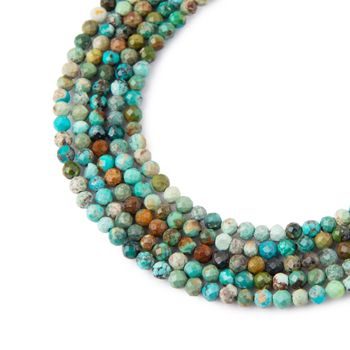
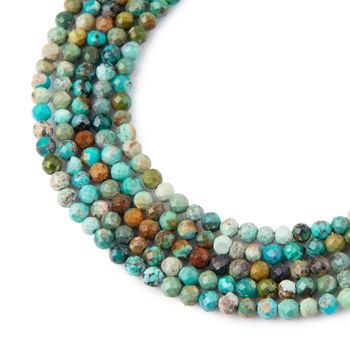
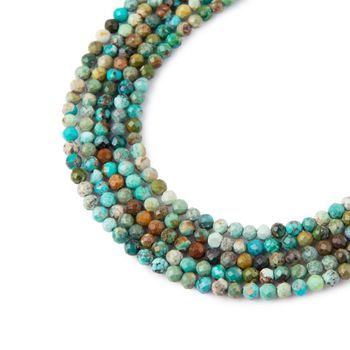
Turquoise (hubei turquoise) is associated above all with protective properties. It is said to provide its wearer with protection from danger, negative energy and accidents. It has a characteristic blue and green colour, though it can also range from light blue-green to dark blue-green shades. It is traditionally linked to Astarte, the Phoenician and Punic goddess of love, passion and fertility. Turquoise is often associated with supporting communication and self-expression, as it reportedly helps its wearer express thoughts and feelings through clear and honest communication. It is also said to support the ability to listen to and understand others.
People also seek it out for its reportedly harmonising properties. Turquoise is said to help balance emotions and find inner peace. In alternative medicine it is used for its reportedly calming effect on the mind and for reducing stress. In many cultures turquoise is regarded as a stone of luck and good fortune. It is often recommended for creative people, as it is associated with supporting creativity and abundance. It reportedly supports artistic development.
We offer two types of turquoise, including the one described above. They differ not only in colour but also in their characteristic properties and different effects. These include:
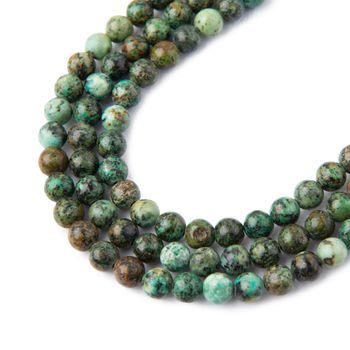
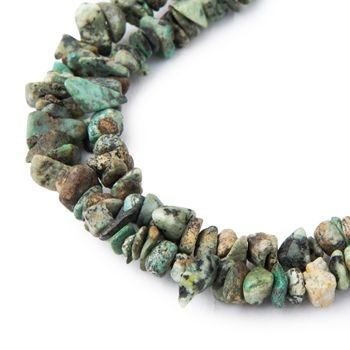
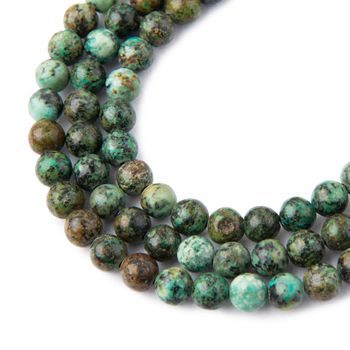
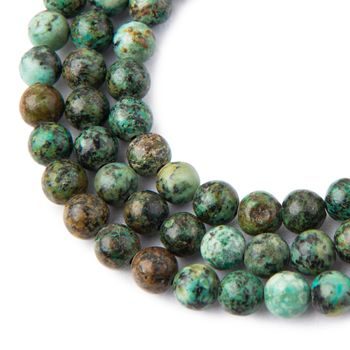
African turquoise (african turquoise) is associated with calm and harmony. It reportedly helps its wearer evoke feelings of inner peace and balance of the soul. It has a calming effect on the mind and is said to reduce anxiety. It has a light azure to intense turquoise colour, with shades of blue and green. It is regarded as a protective stone. It is also often associated with supporting communication and self-expression, reportedly helping its wearer express their thoughts and themselves clearly and confidently, and communicate openly with others. It is equally popular for its reported ability to attract luck, wealth, prosperity and abundance into one's life. It is also often associated with boosting confidence and courage in achieving financial and material goals.
African turquoise is suitable for these zodiac signs:
Gemini (22 May - 21 Jun), Sagittarius (23 Nov - 21 Dec) and Pisces (21 Feb - 20 Mar)
Chakras associated with African turquoise:
Chakra 4 - the heart chakra, Anahata: affects the heart, associated with compassion and love
Chakra 5 - the throat chakra, Vishuddha: affects communication and self-expression
Chakra 6 - the third eye, Ajna: affects intuition, spiritual vision and clairvoyance
Gemini (22 May - 21 Jun), Sagittarius (23 Nov - 21 Dec) and Pisces (21 Feb - 20 Mar)
Take a look at our encyclopedia of minerals by zodiac sign too and find out more here >>>
Turquoise occurs in many places around the world. However, the most significant localities are Iran, the USA, the Sinai Peninsula, China and Mexico.
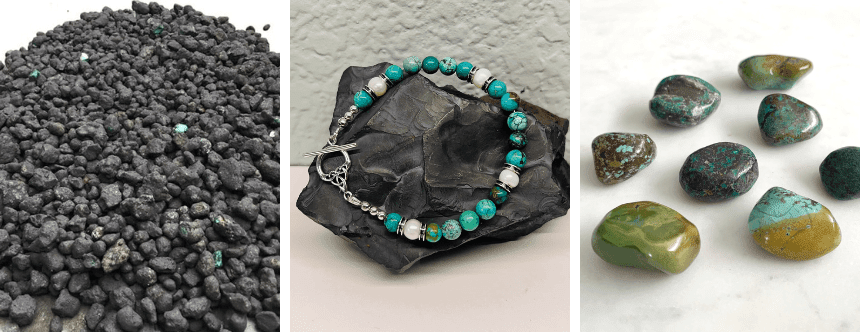
In nature, turquoise is found in the form of veins and veinlets that are part of other rocks. These can be of varying thickness. Round or oval shapes, so-called nodules, are also not uncommon. Turquoise can also be found in massive or scaly form. Natural turquoise is said to have very strong properties. On the Mohs hardness scale it corresponds to 5-6.
The history of turquoise dates back to ancient times. The ancient Egyptians, Greeks, Persians, Aztecs and Mayans already used turquoise in jewellery-making and sculpture, as well as for its reportedly protective properties as an amulet. In the Middle Ages it later became very popular, especially among the nobility and royal families of Europe. It was also often used in religious artefacts and reliquaries. Turquoise was also a traditional and important stone for the indigenous peoples of North America, such as the Navajo. This mineral was used to make jewellery, but also for rituals.
In ancient cultures it was believed that if the colour of turquoise changed or darkened, its wearer was in grave danger?
The striking colour of turquoise is very popular in the jewellery industry, especially for making bracelets and necklaces of both simple and more elaborate designs, which beautifully accent the wearer's neckline. It gives the whole outfit a very refreshing and striking look. Another popular piece of jewellery made from turquoise is earrings and rings, where turquoise usually features as the main stone or as decoration alongside it. Turquoise rings are highly prized for their beauty. Turquoise is also often combined with other minerals, precious metals, pearls or coral, creating an interesting contrast.
Turquoise is also often used to make amulets and talismans, pendants of various shapes, decorations and figurines, buttons and other clothing ornaments, or combs and hair clips.
Chakra 4 - the heart chakra, Anahata: affects the heart, associated with compassion and love
Chakra 5 - the throat chakra, Vishuddha: affects communication and self-expression
Chakra 6 - the third eye, Ajna: affects intuition, spiritual vision and clairvoyance
Take a look at our encyclopedia of minerals by chakra too and find out more here >>>
NOTICE: The information about the properties of precious stones and minerals found on all e-shops operated by Manumi Crafts s.r.o. is not intended for the diagnosis or treatment of any illness, and does not replace or serve as an alternative to conventional medical care. All information given about the potential properties of minerals is based solely on publicly available sources that cannot be factually verified. All precious stones and minerals in our range are intended solely for aesthetic and decorative purposes.



| In design | natural mineral |
| Size | 4 mm |
| Hole width | 0,7 mm |
| Product code | 48998 |
| In design | natural mineral |
| Size | 3 mm |
| Hole width | cca 0,5 - 0,7 mm |
| Product code | 49331 |
| In design | natural mineral |
| Size | 4 mm |
| Hole width | cca 0,8 - 1 mm |
| Product code | 49332 |
| In design | natural mineral |
| Size | 5 - 8 mm |
| Hole width | 1 mm |
| Product code | 48518 |
| In design | natural mineral |
| Size | 6 mm |
| Hole width | 1 mm |
| Product code | 48999 |
| In design | natural mineral |
| Size | 8 mm |
| Hole width | 1,2 mm |
| Product code | 49000 |
| In design | natural mineral |
| Size | 2 mm |
| Hole width | cca 0,4 - 0,6 mm |
| Product code | 49330 |
 Everything is in stock for immediate dispatch
 Affordable delivery to EU
 Traditional Czech glass quality
 Discounted price for larger packages