Close
Close


Your shopping basket is empty
We offer so much stuff that you can't choose? :-)
Contact us, We will be happy to advise you
Get to know prehnite up close in our encyclopedia, which you can view below by clicking Show more. ↓
Interested in something specific? Skip the text and jump straight to the topic Symbolism and healing properties, Suitable zodiac signs, Localities and history, What is the mineral used for and what can you make from it? or Connection with chakras.
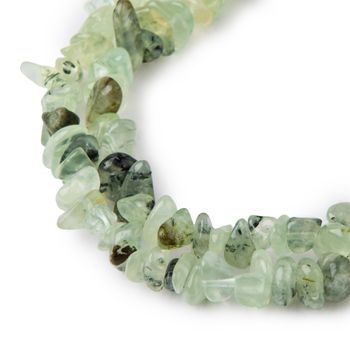
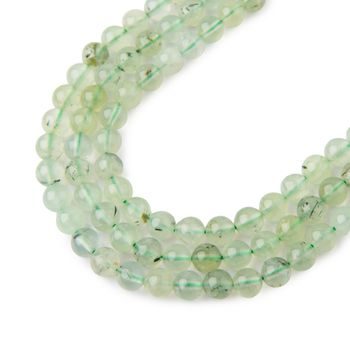
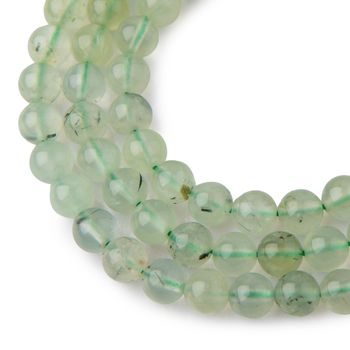
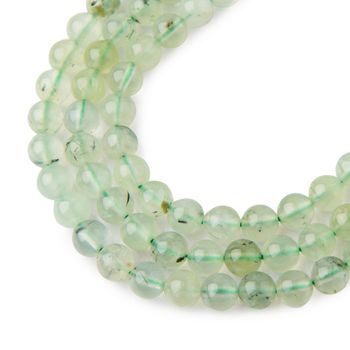
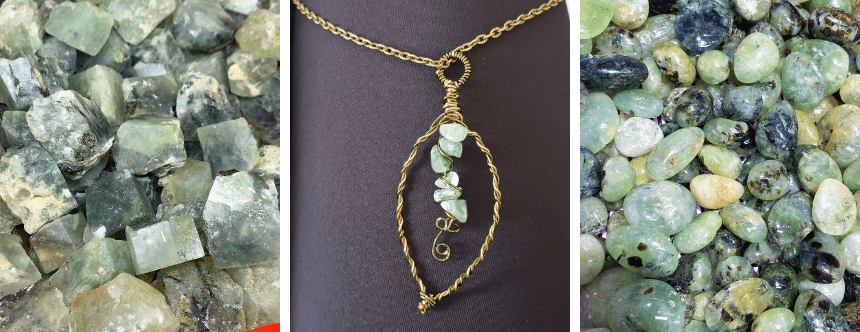
Prehnite (AA grade) is associated primarily with love and compassion. It reportedly symbolises openness of the heart, inner harmony and the ability to express love and compassion in relationships and towards the world. It has various shades of green, from lighter tones to dark. Some prehnites can also be yellow, white-green to blue. The colour spectrum of prehnites can vary depending on the place of origin. It is traditionally associated with the Greek goddess of love and beauty, Aphrodite. According to astrology, it has supportive effects when it comes to fertility and abundance in various areas of life.
People also seek it out for its reportedly protective effects, and it is often considered a protective stone. It is believed to be able to remove negative energy and protect against evil influences and negative emotions. In alternative medicine it is used to harmonise energies in the body. It is widely sought after for its reportedly supportive effects on spiritual growth and intuition. It is often associated with the search for inner wisdom and increasing receptiveness.
Gemini (22 May to 21 June), Libra (23 September to 23 October), Scorpio (24 October to 22 November) and Sagittarius (23 November to 21 December)
Also take a look at our encyclopedia of minerals by zodiac sign and find out more here >>>
Prehnite occurs in many places around the world. The most significant localities are South Africa, Australia, the USA and Germany.
In nature, prehnite is found in the form of crystals of various shapes and sizes. It can occur in the form of needles, columns or small pyramids, as well as grains, flakes or fine fibres. In every case it reportedly has very strong properties and is widely used across fields around the world. On the Mohs scale it corresponds to a hardness of 6–6.5.
The history of prehnite dates back to ancient times, specifically to Egypt, where prehnite was already found more than 4,000 years ago. It was particularly popular among the pharaohs. It was used to make jewellery, statuettes and religious artefacts. The pharaohs considered it a symbol of fertility and renewal. In ancient Greece and Rome it was revered as a stone of love and relationships, reportedly having strong harmonising effects. During the Renaissance it later became popular among the nobility.
Prehnite is named after the Norwegian colonel Hendrik von Prehn? Hendrik von Prehn was a passionate collector and lover of precious stones.
Prehnite has a very attractive appearance and properties that make it simply unique. It has become very popular in jewellery-making, where polished prehnites, shaped into smooth, glossy stones, are used to make bracelets, necklaces, rings and earrings. It is also used in its natural state. Combinations with other stones and materials look very good.
You can also make various decorative items and ornaments from prehnite. You can also make amulets and talismans from it. It is equally popular to make figurines, statuettes and other decorative items from it. Daggers are also made from it.
3rd chakra – solar plexus chakra Manipura: reportedly affects self-confidence and personal strength
4th chakra – heart chakra Anahata: reportedly affects the heart area, associated with compassion and love
Also take a look at our encyclopedia of minerals by chakra and find out more here >>>
NOTICE: The information about the effects of precious stones and minerals found on all e-shops of the company Manumi Crafts s.r.o. is not intended for the diagnosis or treatment of any illness, and does not replace or serve as an alternative to conventional medical care. All information provided about the potential effects of minerals is based solely on publicly available sources, which cannot be factually verified. All precious stones and minerals in our range are intended solely for aesthetic and decorative purposes.



| In design | natural mineral |
| Size | 5 - 8 mm |
| Hole width | 1 mm |
| Product code | 48470 |
| In design | natural mineral |
| Size | 4 mm |
| Hole width | 0,6 mm |
| Product code | 48914 |
| In design | natural mineral |
| Size | 8 mm |
| Hole width | 1 mm |
| Product code | 48916 |
| In design | natural mineral |
| Size | 6 mm |
| Hole width | 0,8 mm |
| Product code | 48915 |
 Everything is in stock for immediate dispatch
 Affordable delivery to EU
 Traditional Czech glass quality
 Discounted price for larger packages