Close
Close


Your shopping basket is empty
We offer so much stuff that you can't choose? :-)
Contact us, We will be happy to advise you
Get to know malachite up close in our encyclopedia, which you can view below by clicking Show more. ↓
Interested in something specific? Skip the text and jump straight to Symbolism and healing properties, Suitable zodiac signs, Localities and history, What is the mineral used for and what can you make from it? or Connection with chakras.
Malachite is associated with the heart and love. Its colour is a deep green, ranging from lighter tones through dark green, all the way to emerald green. It is traditionally linked to Hathor, the Egyptian goddess of love, beauty, fertility and protection, who was also the goddess of dance, music and joy. It reportedly has a harmonising effect, particularly in the area of romantic relationships. In astrology, this gemstone is also considered a stone of protection.
People also seek it out for its supportive effects on transformation and change. It reportedly helps a person find the strength and courage to overcome obstacles, and to cope with life changes. Malachite is also associated with the energy of growth and abundance. It is said to attract prosperity, wealth and success. It is very suitable for entrepreneurs and those who long to live in abundance. In alternative medicine it is used for its reported detoxifying effects. It is also often associated with protecting the aura and cleansing the energy field.
Gemini (22 May to 21 June), Cancer (22 June to 22 July), Libra (23 September to 23 October) and Scorpio (24 October to 22 November)
Also take a look at our encyclopedia of minerals by zodiac sign and find out more here >>>
The best-known locality of malachite is the Democratic Republic of the Congo. It is also one of the largest producers of this gemstone. Other major localities include Russia, Australia, the USA and South Africa.
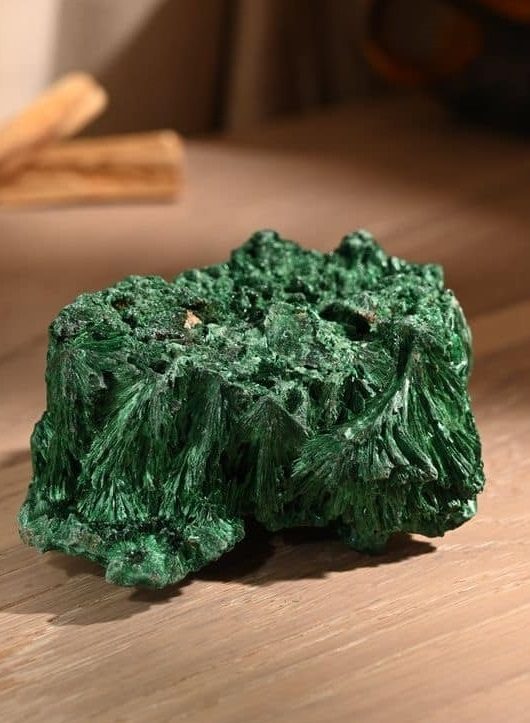
In nature it occurs in the form of crystals, which take the shape of hexagonal columns and needles. It is also found in the form of veins, cylinders or round nodules shaped by erosion, as a base mass forming part of various rocks, or as dust. In any case, natural malachite reportedly has really strong properties. On the Mohs hardness scale it corresponds to a hardness of 3.5 to 4.
Malachite was already a very popular stone in ancient Egypt, where it was used to make jewellery, statues and tombs. In ancient Greece and Rome it was also used to make amulets and talismans and as a symbol of prosperity and wealth. In the Middle Ages it was used to make furniture, pictures and art objects. Later it became particularly popular for making jewellery.
the Russian Tsar Peter the Great had a malachite room built, the famous room in the Winter Palace in Saint Petersburg, as a gift for the King of Prussia, Frederick William I. The room was made from 55 m2 of malachite, amber and other precious stones, and consisted of 8 rooms. To this day it remains one of the most significant and interesting works of art in history and is considered the "eighth wonder of the world".
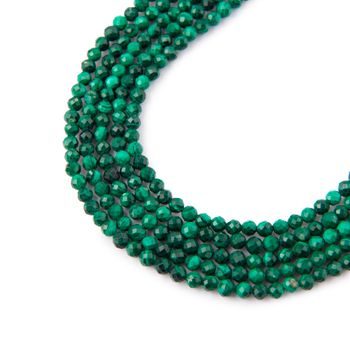
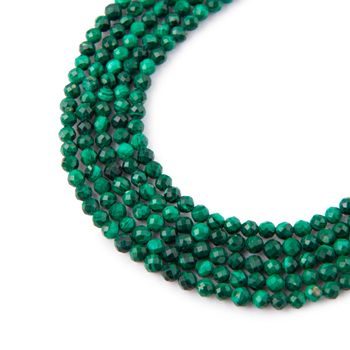
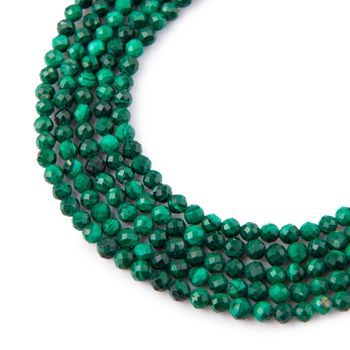
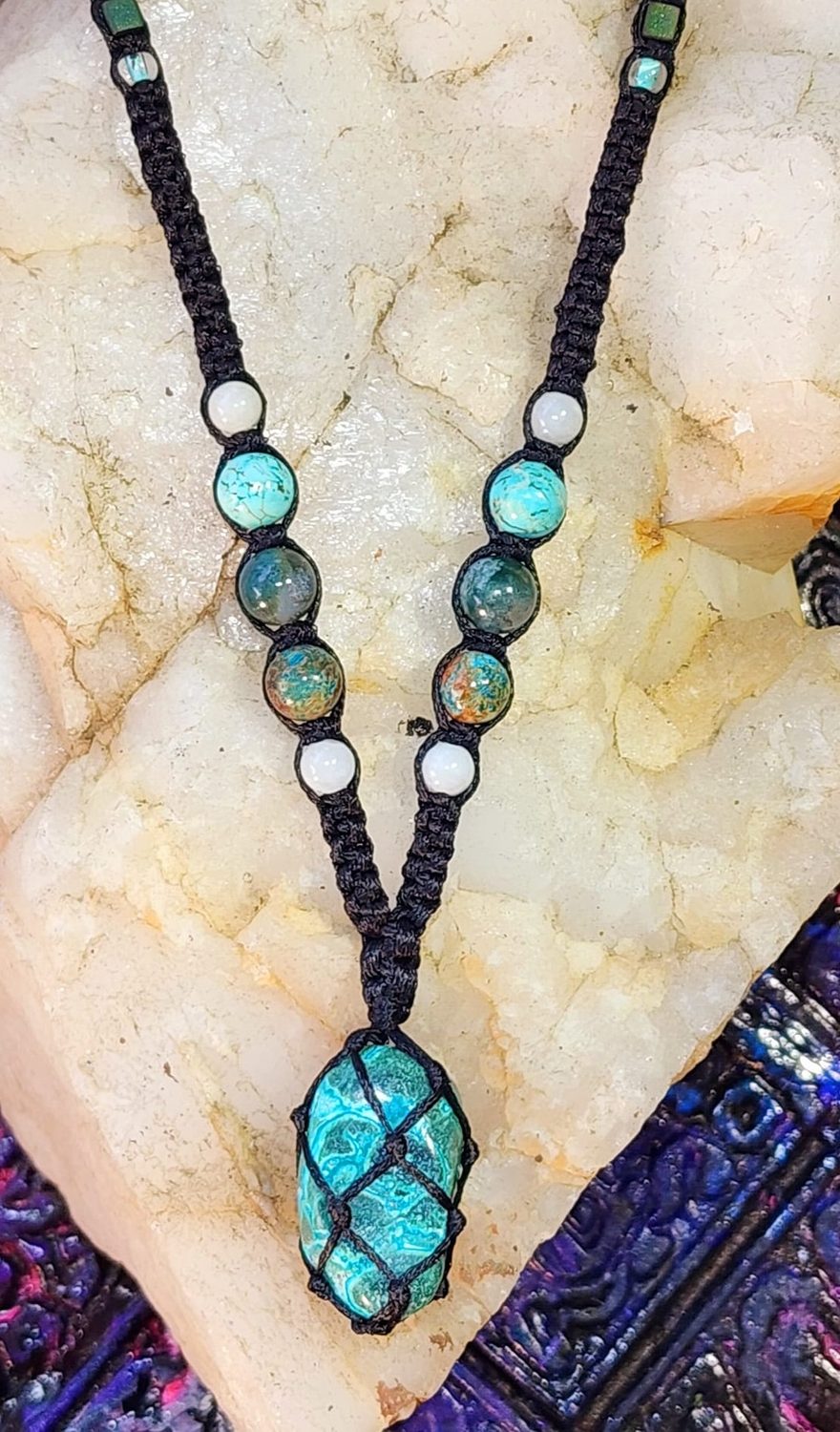
Malachite is a very popular stone in jewellery-making, used to make necklaces, bracelets, earrings, rings, brooches and clasps. Malachite is carved into various shapes. It is used either as the main stone or as small stones combined with other gemstones, such as diamonds or emeralds. It can also be carved into small beads. Jewellery made from malachite has a very natural and elegant look. It is stylish and very beautiful. But you can also make lamps, figurines, candlesticks, vases, board games, buttons, door handles, paperweights and picture frames from malachite.
3rd chakra – solar plexus chakra Manipura: affects emotional balance
4th chakra – heart chakra Anahata: affects the heart, associated with compassion and love
6th chakra – third eye Ajna: affects spiritual growth and consciousness
Also take a look at our encyclopedia of minerals by chakra and find out more here >>>

NOTICE: The information on the properties of precious stones and minerals found on all e-shops of the company Manumi Crafts s.r.o. is not intended for the diagnosis or treatment of any illness, and does not replace or serve as an alternative to conventional medical care. All information on the potential properties of minerals is based solely on publicly available sources that cannot be factually verified. All precious stones and minerals in our range are intended exclusively for aesthetic and decorative purposes.



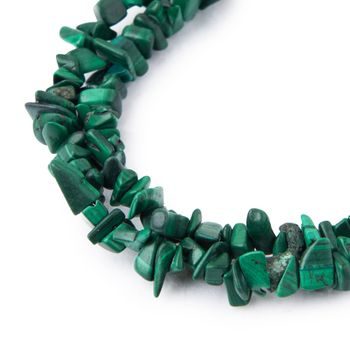
| In design | natural mineral |
| Size | 5 - 8 mm |
| Hole width | 1 mm |
| Product code | 48466 |
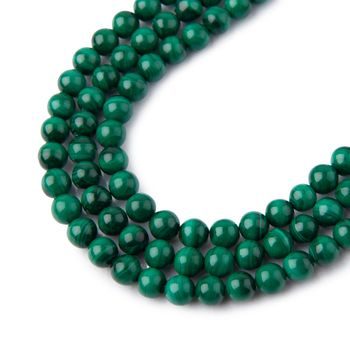
| In design | natural mineral |
| Size | 4 mm |
| Hole width | 0,5 mm |
| Product code | 48848 |
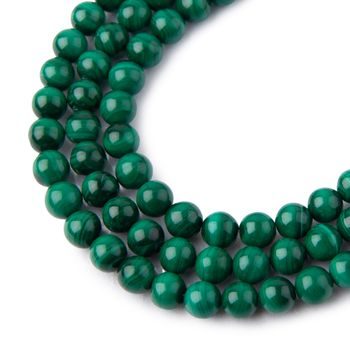
| In design | natural mineral |
| Size | 6 mm |
| Hole width | 1 mm |
| Product code | 48849 |
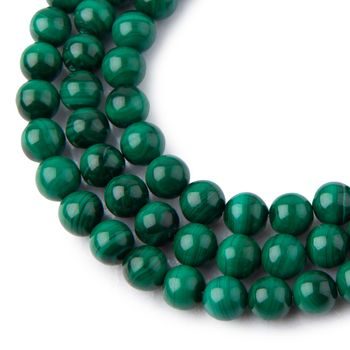
| In design | natural mineral |
| Size | 8 mm |
| Hole width | 1 mm |
| Product code | 48850 |
| In design | natural mineral |
| Size | 2 mm |
| Hole width | cca 0,4 - 0,6 mm |
| Product code | 49445 |
| In design | natural mineral |
| Size | 3 mm |
| Hole width | cca 0,5 - 0,7 mm |
| Product code | 49446 |
| In design | natural mineral |
| Size | 4 mm |
| Hole width | cca 0,8 - 1 mm |
| Product code | 49447 |
 Everything is in stock for immediate dispatch
 Affordable delivery to EU
 Traditional Czech glass quality
 Discounted price for larger packages