Close
Close


Your shopping basket is empty
We offer so much stuff that you can't choose? :-)
Contact us, We will be happy to advise you
Get to know lepidocrocite up close in our encyclopedia, which you can view below by clicking Show more. ↓
Looking for something specific? Skip the text and jump straight to Symbolism and healing properties, Suitable zodiac signs, Localities and history, What is the mineral used for and what can you make from it? or Connection with chakras.
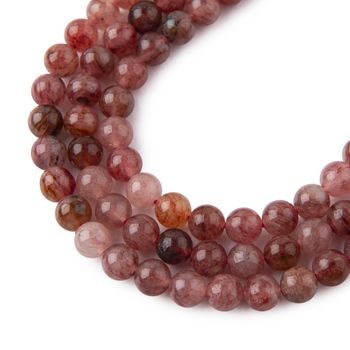
Lepidocrocite (lepidocrocite red quartz) is associated with emotional healing, love and relationships, but also with energy, strength and endurance. It is dark brown to black in colour, often with reddish hues. It is traditionally linked to Kali, the Hindu goddess of death, destruction, transformation and renewal. It reportedly helps its wearer heal their inner child. According to astrology, it has a calming effect, particularly with regard to hyperactivity.
People also seek it out for its reported supportive properties when it comes to communication with higher spiritual beings, especially angels. In alternative medicine, it is used to calm the mind and body, to relax, and to bring about perfect calm for meditation. It is said to help its wearer overcome fears and open their heart to pure and honest love. It is often associated with the awakening of intuition and a stronger perception of the world around us.
Gemini (22 May – 21 Jun), Virgo (23 Aug – 22 Sep) and Aquarius (21 Jan – 20 Feb)
Take a look at our encyclopedia of minerals by zodiac sign and find out more here >>>
Lepidocrocite is a relatively rare mineral, found in only a few localities around the world. The most significant deposit of lepidocrocite is the Ural region in Russia and some parts of the USA.
In nature, lepidocrocite occurs as an iron oxide. It is often found in the form of grains or crusts in rocks such as iron ores or various sediments. Needle-like crystals or aggregates are not uncommon either. Natural lepidocrocite is said to have very strong properties. It is used across many fields around the world. On the Mohs scale, it has a hardness of 5.
Lepidocrocite was first named in 1813 by the German mineralogist Friedrich Mohs. It was originally called "lepidocrocite clay" because of its clay-like appearance. It was later identified as a separate mineral and classified within the mineral system.
Did you know lepidocrocite is linked to extraterrestrial life? This theory stems from research into lepidocrocite found in Antarctica, and later in other regions, which bore traces of diatom life – single-celled algae, as we call them on Earth. Interestingly, these algae are dated to a period when, according to all scientific theories, the Earth should not yet have existed.
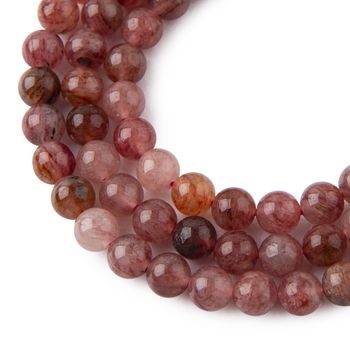
Lepidocrocite is a fairly popular mineral in the jewellery industry for its unique appearance and interesting lustre. It is either kept in its classic form and simply polished, or cut into various shapes, mainly beads. These are then used to make necklaces, bracelets, and also earrings or rings. It is often combined with other semi-precious stones and precious metals to achieve maximum effect. In any case, jewellery made from lepidocrocite looks truly beautiful and unique.
People also use lepidocrocite to make talismans and amulets. Although it is not as well known as other minerals, it can also be used to decorate candlesticks, jewellery boxes, pictures, vases or, for example, to make a dreamcatcher.
4th chakra – heart chakra Anahata: is said to affect the heart, associated with compassion and love
5th chakra – throat chakra Vishuddha: is said to affect communication and self-expression
Take a look at our encyclopedia of minerals by chakra and find out more here >>>

NOTICE: Information about the properties of precious stones and minerals found on all Manumi Crafts s.r.o. e-shops is not intended for the diagnosis or treatment of any illness, and does not replace or serve as an alternative to conventional medical care. All information provided about the potential properties of minerals is based solely on publicly available sources that cannot be factually verified. All precious stones and minerals in our range are intended solely for aesthetic and decorative purposes.



| In design | natural mineral |
| Size | 6 mm |
| Hole width | 1 mm |
| Product code | 49149 |
| In design | natural mineral |
| Size | 8 mm |
| Hole width | 1 mm |
| Product code | 49150 |
 Everything is in stock for immediate dispatch
 Affordable delivery to EU
 Traditional Czech glass quality
 Discounted price for larger packages