Close
Close


Your shopping basket is empty
We offer so much stuff that you can't choose? :-)
Contact us, We will be happy to advise you
Get to know apatite up close in our encyclopedia, which you can view below by clicking Show more. ↓
Interested in something specific? Skip the text and jump straight to Symbolism and healing properties, Suitable zodiac signs, Localities and history, What is the mineral used for and what can you make from it? or Connection with chakras.
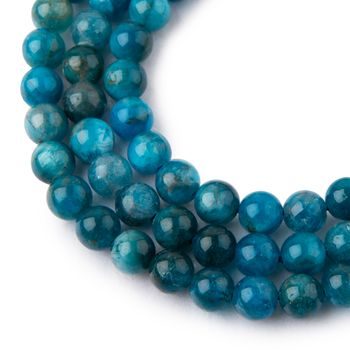
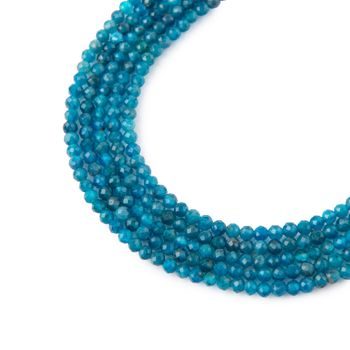
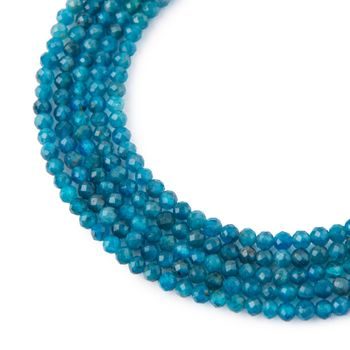
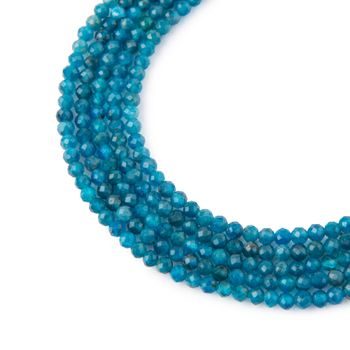
Apatite (apatite A) is associated above all with spiritual growth, awareness and intuition. It can be blue, green, yellow, brown or purple in lighter or darker shades, though sometimes it is completely transparent. It is traditionally linked to the Hindu goddess of abundance, prosperity, wealth, luck and love, Lakshmi. According to astrology, it reportedly has a calming effect. It is said to help reduce stress and anxiety.
People also seek it out for its reportedly harmonising effect on the emotional sphere. It is said to help boost self-confidence and motivate its wearer. It reportedly kindles the inner flame needed to reach one's desired goals. It is also said to have a very positive effect on self-esteem. In alternative medicine it is used to balance the body's energies. Apatite is also linked to communication and self-expression. It is said to make it easier to express one's thoughts and feelings clearly and confidently. It is also believed to support creativity. Above all, though, it tends to be associated with opening up to higher planes of consciousness.
Gemini (22 May to 21 June) and Libra (23 September to 23 October)
Also take a look at our mineral encyclopedia by zodiac sign and find out more here >>>
The most significant producer of apatite is Russia. Other important localities include Morocco, the USA, Canada, Brazil and South Africa.
In nature, apatite occurs in the form of crystals of various shapes, ranging from columnar to tabular, small or striking. It is also often found in the form of sediments, flakes or needles, grains or veins. In any case, natural apatite reportedly has very strong properties, and is therefore widely used across many fields around the world. On the Mohs scale it corresponds to a hardness of 5.
Apatite has a very rich history. The ancient Egyptians already knew it and considered this mineral a stone of health. They associated it with beneficial effects on emotional healing. They made amulets and ritual objects from it, which were said to protect against illness and evil. In ancient Greece and Rome it was highly prized for its extraordinary beauty. It was used to make statues, jewellery and art objects. Alchemists were also fond of it. In their view, it played an important role in developing intuition and opening spiritual visions.
Apatite is a natural component of tooth enamel and bones? In medicine it is used to make implants, orthopaedic implants and bone substitutes. Apatite materials are able to bond with bone, which supports the regeneration of bone marrow.
Apatite is not a particularly hard stone, so it needs to be handled carefully. However, it is very popular in jewellery-making for its striking colours. It is often used to make elegant necklaces, bracelets (especially anklets), rings including those set in precious metals, as well as brooches and hair clips, which are made mainly from smaller apatite stones.
Apatite is also used in the production of ceramics, glass and enamel. You can use it to make figurines, vases, ornaments, and thanks to its reportedly protective properties it also serves as a talisman. It can also be used as a decorative stone.
3rd chakra – solar plexus Manipura: reportedly affects self-confidence and personal power
5th chakra – throat chakra Vishuddha: reportedly affects communication and self-expression
6th chakra – third eye Ajna: reportedly affects intuition, spiritual vision and clairvoyance
Also take a look at our mineral encyclopedia by chakra and find out more here >>>

NOTICE: The information about the properties of gemstones and minerals found on all e-shops of Manumi Crafts s.r.o. is not intended for the diagnosis or treatment of any illness, and does not replace or serve as an alternative to conventional medical care. All information provided about the potential properties of minerals is based solely on publicly available sources that cannot be factually verified. All gemstones and minerals in our range are intended solely for aesthetic and decorative purposes.



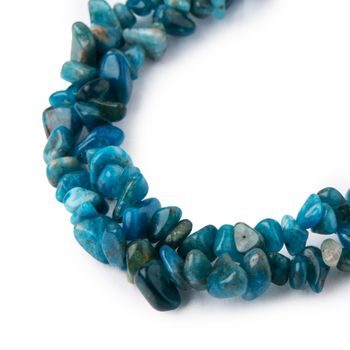
| In design | natural mineral |
| Size | 5 - 8 mm |
| Hole width | 1 mm |
| Product code | 48459 |
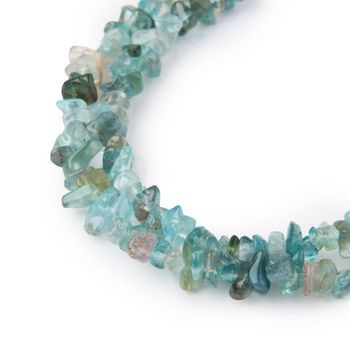
| In design | natural mineral |
| Size | 5 - 8 mm |
| Hole width | 1 mm |
| Product code | 48503 |
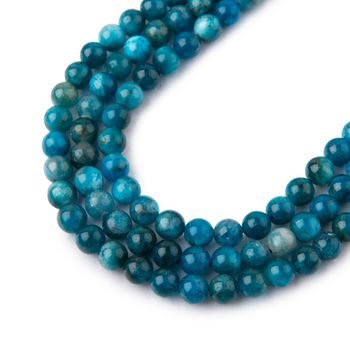
| In design | natural mineral |
| Size | 4 mm |
| Hole width | 0,8 mm |
| Product code | 48680 |
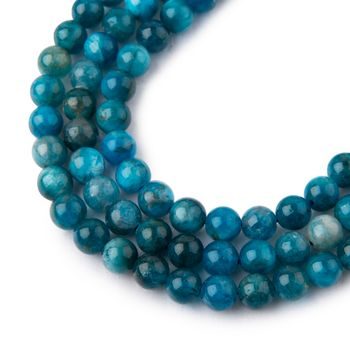
| In design | natural mineral |
| Size | 6 mm |
| Hole width | 1 mm |
| Product code | 48681 |
| In design | natural mineral |
| Size | 8 mm |
| Hole width | 1,2 mm |
| Product code | 48682 |
| In design | natural mineral |
| Size | 2 mm |
| Hole width | cca 0,4 - 0,6 mm |
| Product code | 49384 |
| In design | natural mineral |
| Size | 4 mm |
| Hole width | cca 0,8 - 1 mm |
| Product code | 49386 |
| In design | natural mineral |
| Size | 3 mm |
| Hole width | cca 0,5 - 0,7 mm |
| Product code | 49385 |
 Everything is in stock for immediate dispatch
 Affordable delivery to EU
 Traditional Czech glass quality
 Discounted price for larger packages